Thursday, January 07, 2016

Porsche 918 Spyder

Electric drive

= 1 = Charging equipment
For convenient home charging, we recommend the installation of an industrial electrical outlet and use of the Charging Dock, which has been specially styled by Porsche Design and comes as standard. During AC charging, the alternating current of the mains supply is converted into direct current by the vehicle’s on-board charger for charging the traction battery.

The especially powerful Porsche Speed Charging Station (DC) rated at 20 kW is available as an option. It is intended for permanent installation and reduces charging time to under half an hour.
Our ‘Porsche Car Connect’ smartphone app, including a range of e-mobility services, is available to allow you to manage and monitor your vehicle remotely, for example during the charging process.

Fuel consumption* 918 Spyder (combined): 3.1 l/100 km; CO2 emissions (combined) 72 g/km. Electricity consumption 12.7 kWh/100 km.
Fuel consumption* 918 Spyder with Weissach package (combined): 3.0 l/100 km; CO2 emissions (combined) 70 g/km. Electricity consumption 12.7 kWh/100 km.
* These data were obtained using the Euro 5 measurement method (715/2007/EC and 692/2008/EC) in the NEDC (New European Driving Cycle) with standard equipment. The information does not refer to an individual vehicle and is not part of the offer, but is simply provided so that comparisons can be made between different types of vehicle. Further, up to date information on the individual vehicles can be obtained from your Porsche Centre.
Consumption figures were obtained on the basis of standard equipment. Special equipment may affect consumption and performance.

= 2 = Electric machines
The two electric machines impress with an exceptionally high power output for their weight and size. They offer a combined mechanical power output of over 210 kW
(286 hp), with 95 kW (129 hp) produced at the front axle and 115 kW (156 hp) at the rear. As a result, the 918 Spyder boasts the highest electric machine power output of any production hybrid. The all-electric top speed is up to 150 km/h.

Another benefit of the electric drive is its incredibly fast response – for extremely fast acceleration from a standing start. It enables a fast-acting electric all-wheel-drive function. For weight reasons, the electric machine at the front axle has a constant gear ratio. The result is an enormous amount of tractive power at the wheels even while the V8 high-revving engine is still operating in the low speed range. This effect is further amplified in the higher gears. This kind of arrangement means that the electric machine at the front axle reaches maximum rpm at 265 km/h and is then decoupled.
the electric drive is significantly more efficient than a combustion engine across the wide speed range – with an efficiency of approximately 90 % in most load ranges.
Above all, however, electric machines can be used to recuperate energy, which can be
 used later to provide an additional e-boost.


Fuel consumption* 918 Spyder (combined): 3.1 l/100 km; CO2 emissions (combined) 72 g/km. Electricity consumption 12.7 kWh/100 km.
Fuel consumption* 918 Spyder with Weissach package (combined): 3.0 l/100 km; CO2 emissions (combined) 70 g/km. Electricity consumption 12.7 kWh/100 km.
* These data were obtained using the Euro 5 measurement method (715/2007/EC and 692/2008/EC) in the NEDC (New European Driving Cycle) with standard equipment. The information does not refer to an individual vehicle and is not part of the offer, but is simply provided so that comparisons can be made between different types of vehicle. Further, up to date information on the individual vehicles can be obtained from your Porsche Centre.
Consumption figures were obtained on the basis of standard equipment. Special equipment may affect consumption and performance.

= 3 = High-performance traction battery
The traction battery has a exceedingly high energy content, a very fast power output and according electric boost of the electric machines.

It can be recharged by the mains supply via the charging socket (plug-in) on the vehicle. The battery also recharges in different ways while the vehicle is in motion:
One is in recuperation mode, whereby a portion of the vehicle’s kinetic energy is converted into electrical energy by the electric machines, for example under braking.
In a second scenario the combustion engine can drive the rear electric machine, which then operates as a generator and charges the traction battery in the process. The principle: load point displacement. The result: greater energy reserves for extremely fast lap times. Or for driving in purely electric mode.

= 4 = Porsche e-mobility
In view of an all-electric top speed of 150 km/h and a maximum torque of 475 Nm from a standing start, you will come to regard electricity in a completely new light. Thanks in part to recuperation, e-boost and the electric all-wheel drive system, electricity will be your new guarantee of driving pleasure.

Delivering a fuel consumption of 3.3–3.0 litres per 100 km (depending on the vehicle variant) and with an all-electric range of 31 km (measured in the NEDC), the interaction of the three drive units in the 918 Spyder shows that performance is not always a question of brawn but brains too.
The 918 Spyder is a future model in terms of performance. Or quite simply a super sports car in the form of a plug-in hybrid.

Classic drive

= 1 = V8 High-revving engine
Thanks to a power output of more than 447 kW (608 hp), the high-performance unit attains the level of a racing engine. That’s what we call motorsport DNA. Its low weight of around only 135 kg and its low position provide the optimum prerequisites to extremely dynamic driving performance and ultra precise power delivery – on the racetrack and on the road.

The unit is also equipped with drysump lubrication with a separate oil tank, scavenge pumps in aluminium and connecting rods in titanium. Not to mention a flat, lightweight crankshaft. All of which means weight down, power up.

Fuel consumption* 918 Spyder (combined): 3.1 l/100 km; CO2 emissions (combined) 72 g/km. Electricity consumption 12.7 kWh/100 km.
Fuel consumption* 918 Spyder with Weissach package (combined): 3.0 l/100 km; CO2 emissions (combined) 70 g/km. Electricity consumption 12.7 kWh/100 km.
* These data were obtained using the Euro 5 measurement method (715/2007/EC and 692/2008/EC) in the NEDC (New European Driving Cycle) with standard equipment. The information does not refer to an individual vehicle and is not part of the offer, but is simply provided so that comparisons can be  made between different types of vehicle. Further, up to date information on the individual vehicles can be obtained from your Porsche Centre.
Consumption figures were obtained on the basis of standard equipment. Special equipment may affect consumption and performance.

= 2 = Exhaust system with top pipes
Top pipes are not only new to the road, they are new for Porsche. The concept comes from the racetrack and proves unequivocally where the 918 Spyder feels at home.

During the series production development process, our engineers were unhappy to accept that the particularly effective exhaust concept used in motorsport could not be transferred to a road vehicle, or at least to a super sports car.
So they adopted a completely new approach, resulting in a new type of thermodynamic air routing concept that has enabled the use of extremely short exhaust gas channels: the gases are expelled from the car through the top pipes directly above the engine. The associated reduction in exhaust backpressure has a positive impact on power output and fuel economy. The audible effect is heard in the resonant Porsche sound that reveals the motorsport genes of the 918 Spyder.
Another welcome advantage in terms of the technical requirements of a plug-in hybrid is that the heat of the combustion engine is dissipated more rapidly from the vehicle. Last, but not least, the top pipes on the 918 Spyder also serve to emphasise its pure racing character. Let’s just call it a pleasant side effect.

= 3 = Porsche Doppelkupplung
For the refined version of Porsche Doppelkupplung (PDK) shift times and shift programmes have been further optimised. PDK changes gear automatically, but you can still take manual control using the gearshift paddles on the sports steering wheel. Gear changes take place in milliseconds with no interruption in the flow of power. Just like in motorsport.

Performance hybrid

= 1 = Performance hybrid
The 918 Spyder can be driven at the rear axle by the combustion engine, by the rear electric machine alone or by both together. Depending on the selected drive strategy, an additional electric machine will be activated to drive the front axle. The distribution of power between the axles is automated and it is regulated by a new type of drive control system, namely Electric Porsche Traction Management (ePTM).

The 918 Spyder attains exceptional overall performance values using three sources of drive: a total system power output of more 652 kW (887 hp) and a total system torque of more than 800 Nm in the 800 to 5,000 rpm range. In 7th gear, the result is a maximum crankshaft torque of over 1,280 Nm.
For you, that means exceptionally high torque even at low engine speeds, harmonious power development over the full engine speed range and a very high maximum engine speed of 9,150 rpm.

= 2 = High-performance hybrid braking system
The high-performance hybrid braking system uniquely combines excellent recuperation performance with an authentic brake pedal feel.

The intelligent hydraulic system fades between the electric brakes and the hydraulic brakes of the PCCB brake system – a process imperceptible to the driver – and ensures constant feedback in the brake pedal in every driving situation as you would rightly expect from any Porsche.

Driving dynamics

= 1 = Electric Porsche Traction Management
Torque is distributed between the front and rear axles actively and extremely quickly by control of the electric machine at the front axle. Sensors check, among other variables, the rotation speeds of all four wheels, the longitudinal and lateral acceleration of the vehicle, and the steering angle. By evaluating all data, the system can quickly adjust the distribution of drive force between the front and rear axles in order to achieve optimum balance.

In this way, ePTM, in conjunction with Porsche Stability Management (PSM) and anti-slip regulation (ASR), ensures that forces are distributed appropriately in every driving situation to provide excellent acceleration. The results are a high degree of safety and outstanding performance combined with exemplary balance.

= 2 = Porsche Torque Vectoring Plus
Porsche Torque Vectoring Plus (PTV Plus) enhances driving dynamics and stability. The system works by intelligently braking the rear wheels and operates in conjunction with a fully variable and electronically regulated rear differential lock.

For the driver, this means remarkable lateral stability and outstanding traction as well as greater agility at every speed – attributes that are essential at the limits of sporty performance, not least because they are key to sustaining increased driving pleasure.

= 3 = Porsche Active Suspension Management
At the press of a button, you can select between two different modes: ‘Normal’ and ‘Sport’. ‘Normal’ mode is designed for sporty driving on public roads and on wet racetracks. ‘Sport’ mode is specially tuned for maximum lateral acceleration and offers the best possible traction on the track.

Axles

= 1 = Rear-axle steering
An electromechanical adjustment system at each rear wheel allows the wheels to turn a few degrees in either direction as a function of driving speed.

During low-speed manoeuvres, the system steers the rear wheels in the opposite direction to that of the front wheels. This has the virtual effect of shortening the wheelbase for perceptibly more dynamic steering into corners. The turning circle is reduced, which makes it easier to manoeuvre.
During high-speed manoeuvres, the system steers the rear wheels in the same direction as that of the front wheels. This virtual extension of the wheelbase helps to increase driving stability.

= 2 = Porsche Ceramic Composite Brake (PCCB)
The brake system of the 918 Spyder had to be a proven racetrack performer of the kind fitted to cars participating in the Porsche Mobil 1 Supercup, for example. The brake discs have a diameter of 410 and 390 mm at the front and rear, respectively. The six-piston monobloc aluminium fixed brake calipers at the front axle and four-piston units at the rear, all painted in Acid Green, ensure a powerful and, above all, constant braking effect.

The key advantage of PCCB is its extremely low weight, with ceramic brake discs that are approximately 50 % lighter than standard discs of a similar design. As well as enhancing performance and fuel economy, this represents a major reduction in unsprung and rotating masses.

= 3 = Wheels
The car is equipped with 20-inch wheels at the front axle and 21-inch wheels at the rear. The black painted finish on the rims contrasts with the highly polished surfaces on the front to create a stunning three-dimensional effect. Thanks to their size, they offer benefits with respect to dynamic performance and rolling resistance.

The 918 Spyder magnesium wheel is available on request – and is fitted as standard to the 918 Spyder with Weissach package. The forged one-piece magnesium wheels are especially light and yet extremely robust. The design, borrowed from the RS Spyder, permits optimum material usage. By comparison with the standard wheels, they offer a weight advantage of approximately 14.9 kg.
Both wheels have the characteristic central locking device from motorsport in common – a crucial advantage when the timer on the racetrack is ticking.

Cockpit

= 1 = Multifunction sport steering wheel
The map switch is at the heart of this philosophy. It enables you to select any one of four drive modes plus a Hot Lap configuration.

Gearshift paddles allow motorsport- style gear changes. Positions D, N and R are selected by means of a compact lever in the dashboard. Two thumbwheels are conveniently placed for controlling the left and right displays in the instrument cluster.
The three circular instruments in the cut-away dashboard are not only ergonomic, they are style-defining too. As in any Porsche, the analogue rev counter is located centrally in the ‘Power & Drive’ circular instrument. It may exude classic appeal but it also looks to the digital future with an LED power metre display in the outer ring encircling the dial face. It displays the power being delivered by each type of drive.
A digital display informs you of the active gear, your current driving speed and the drive mode. The ‘Speed & Assist’ circular instrument on the left combines speed and cruise control information. To the right of the rev counter is the ‘Car & Info’ instrument with displays for fuel level, on-board computer, battery state of charge, range, gear change assistant and g-force.

= 2 = Centre console with touchscreen and central information display
A state-of-the-art control concept with smartphone-style touch and gesture recognition, character recognition (including Chinese) and three rotary pushbuttons provide intuitive operation of displays and control functions. Displayed content can be customised to your own preference. Embedded in the exquisite centre console, the touch surfaces enable fast navigation and direct operation of functions relating to comfort and convenience, air conditioning, car settings and Porsche Communication Management (PCM), which is integrated as standard.

PCM information is shown in the central 8-inch information display. This is housed in the dashboard behind a panoramic shroud to minimise reflections for optimum readability even on the move.
With touchscreen operation and the information display, we have managed to optimise ergonomics and readability.

= 3 = Porsche Communication Management (PCM)
In the interests of weight saving, PCM dispenses with CD/DVD drives. At the same time, the 918 Spyder has reached the next stage of technical evolution in terms of communication. We’ve focused on connectivity, with two USB interfaces, WLAN and Bluetooth®.
Via WLAN or Bluetooth® on your smartphone, you can connect PCM directly to the Internet and display or use various online services, like weather forecasts or Internet radio, in PCM. Of course, you can also access the media content of a portable device, such as an MP3 player, or the media library of your smartphone and have the Cover Flow interface appear in PCM.
A hands-free function enables direct access to your personal address book as well as SMS and e-mails. For e-mails, text-to-speech is additionally supported.
Thanks to the separation of touchscreen and information display, you can edit destination entries or route options and the active route will continue to be shown in the upper information display. An intelligent navigation suggestions search function is sure to be of service. With an active Internet connection established via your smartphone, this will be updated constantly in background.


Labels: , ,

Friday, September 13, 2013

Porsche 918 Spyder

Technology: Electric Drive

Charging Equipment
For convenient home charging, we recommend the installation of an industrial electrical outlet and use of the Charging Dock, which has been specially styled by Porsche Design and comes as standard. During AC charging, the alternating current of the mains supply is converted into direct current by the vehicle’s on-board charger for charging the traction battery.
The especially powerful Porsche Speed Charging Station (DC) rated at 20 kW is available as an option. It is intended for permanent installation and reduces charging time to under half an hour.
Our ‘Porsche Car Connect’ smartphone app, including a range of e-mobility services, is available to allow you to manage and monitor your vehicle remotely, for example during the charging process.

Electric Machines
The two electric machines impress with an exceptionally high power output for their weight and size. They offer a combined mechanical power output of over 210 kW
(286 hp), with 95 kW (129 hp) produced at the front axle and 115 kW (156 hp) at the rear. As a result, the 918 Spyder boasts the highest electric machine power output of any production hybrid. The all-electric top speed is up to 150 km/h.
Another benefit of the electric drive is its incredibly fast response – for extremely fast acceleration from a standing start. It enables a fast-acting electric all-wheel-drive function. For weight reasons, the electric machine at the front axle has a constant gear ratio. The result is an enormous amount of tractive power at the wheels even while the V8 high-revving engine is still operating in the low speed range. This effect is further amplified in the higher gears. This kind of arrangement means that the electric machine at the front axle reaches maximum rpm at 235 km/h and is then decoupled.
the electric drive is significantly more efficient than a combustion engine across the wide speed range – with an efficiency of approximately 90 % in most load ranges.
Above all, however, electric machines can be used to recuperate energy, which can be used later to provide an additional e-boost.

High Performance Traction Battery
The traction battery has a exceedingly high energy content, a very fast power output and according electric boost of the electric machines.
It can be recharged by the mains supply via the charging socket (plug-in) on the vehicle. The battery also recharges in different ways while the vehicle is in motion:
One is in recuperation mode, whereby a portion of the vehicle’s kinetic energy is converted into electrical energy by the electric machines, for example under braking.
In a second scenario the combustion engine can drive the rear electric machine, which then operates as a generator and charges the traction battery in the process. The principle: load point displacement. The result: greater energy reserves for extremely fast lap times. Or for driving in purely electric mode.


Porsche e-mobility
In view of an all-electric top speed of 150 km/h and a maximum torque of 475 Nm from a standing start, you will come to regard electricity in a completely new light. Thanks in part to recuperation, e-boost and the electric all-wheel drive system, electricity will be your new guarantee of driving pleasure.
Delivering a fuel consumption of 3.3–3.0 litres per 100 km (depending on the vehicle variant) and with an all-electric range of 31 km (measured in the NEDC), the interaction of the three drive units in the 918 Spyder shows that performance is not always a question of brawn but brains too.
The 918 Spyder is a future model in terms of performance. Or quite simply a super sports car in the form of a plug-in hybrid.

Technology: Classic Drive

Exhaust system with top pipes
Top pipes are not only new to the road, they are new for Porsche. The concept comes from the racetrack and proves unequivocally where the 918 Spyder feels at home.
During the series production development process, our engineers were unhappy to accept that the particularly effective exhaust concept used in motorsport could not be transferred to a road vehicle, or at least to a super sports car.
So they adopted a completely new approach, resulting in a new type of thermodynamic air routing concept that has enabled the use of extremely short exhaust gas channels: the gases are expelled from the car through the top pipes directly above the engine. The associated reduction in exhaust backpressure has a positive impact on power output and fuel economy. The audible effect is heard in the resonant Porsche sound that reveals the motorsport genes of the 918 Spyder.
Another welcome advantage in terms of the technical requirements of a plug-in hybrid is that the heat of the combustion engine is dissipated more rapidly from the vehicle. Last, but not least, the top pipes on the 918 Spyder also serve to emphasise its pure racing character. Let’s just call it a pleasant side effect.
Porsche Dopplekupplung
For the refined version of Porsche Doppelkupplung (PDK) shift times and shift programmes have been further optimised. PDK changes gear automatically, but you can still take manual control using the gearshift paddles on the sports steering wheel. Gear changes take place in milliseconds with no interruption in the flow of power. Just like in motorsport.

V8 high-revving engine
Thanks to a power output of more than 447 kW (608 hp), the high-performance unit attains the level of a racing engine. That’s what we call motorsport DNA. Its low weight of around only 135 kg and its low position provide the optimum prerequisites to extremely dynamic driving performance and ultra precise power delivery – on the racetrack and on the road.
The unit is also equipped with drysump lubrication with a separate oil tank, scavenge pumps in aluminium and connecting rods in titanium. Not to mention a flat, lightweight crankshaft. All of which means weight down, power up.

Technology: Performance hybrid

The 918 Spyder as a performance hybrid
The 918 Spyder can be driven at the rear axle by the combustion engine, by the rear electric machine alone or by both together. Depending on the selected drive strategy, an additional electric machine will be activated to drive the front axle. The distribution of power between the axles is automated and it is regulated by a new type of drive control system, namely Electric Porsche Traction Management (ePTM).
The 918 Spyder attains exceptional overall performance values using three sources of drive: a total system power output of more 652 kW (887 hp) and a total system torque of more than 800 Nm in the 800 to 5,000 rpm range. In 7th gear, the result is a maximum crankshaft torque of over 1,280 Nm.
For you, that means exceptionally high torque even at low engine speeds, harmonious power development over the full engine speed range and a very high maximum engine speed of 9,150 rpm.


Four driving modes and Hot Lap configuration
Four different driving modes plus a Hot Lap configuration. They regulate the interaction of the combustion engine and electric machines as appropriate to the driving situation and driving style. You can still intervene at any time, but you don’t have to. The driving mode – and adrenaline level – of your choice is activated manually by means of the map switch on the sports steering wheel
- E-Power is the default operating mode at a standing start. Depending on the state of charge of the battery, the vehicle will cover up to 30 km on electric power alone and reach a speed of 150 km/h. The combustion engine is switched on only as required in response to driver input, i.e. kickdown. This is the ideal mode for all-electric driving
- In Hybrid mode, the 918 Spyder is powered by the electric machine or the combustion engine in a way that achieves optimum fuel consumption. For a conservative, economy- oriented driving style, for example in city traffic, or efficiency-enhanced motoring on major roads
- In Sport Hybrid mode, the combustion engine is always in operation. Support is provided by the electric machines and their e-boost capability, such as when the driver demands higher power output. For a sporty driving style
- The combustion engine is always in operation. The electric machines are allowed to deliver their maximum available power, which further enhances the e-boost effect. A higher proportion of the power generated by the combustion engine goes into recharging the battery. Gearshifts are extremely fast and sporty and the torque potential of the engine is optimally exploited. This enables superlative performance for equally superlative lap times on the racetrack
- When you press the Hot Lap button in Race Hybrid mode, the maximum energy potential of the highperformance traction battery is harnessed to help you achieve the fastest possible lap time. On the Northern Loop of the Nürburgring it could mean shaving around four seconds off your best time


High-performance hybrid braking systemThe high-performance hybrid braking system uniquely combines excellent recuperation performance with an authentic brake pedal feel.
The intelligent hydraulic system fades between the electric brakes and the hydraulic brakes of the PCCB brake system – a process imperceptible to the driver – and ensures constant feedback in the brake pedal in every driving situation as you would rightly expect from any Porsche


Driving Dynamics

Electric Porsche Traction Management
Torque is distributed between the front and rear axles actively and extremely quickly by control of the electric machine at the front axle. Sensors check, among other variables, the rotation speeds of all four wheels, the longitudinal and lateral acceleration of the vehicle, and the steering angle. By evaluating all data, the system can quickly adjust the distribution of drive force between the front and rear axles in order to achieve optimum balance.
In this way, ePTM, in conjunction with Porsche Stability Management (PSM) and anti-slip regulation (ASR), ensures that forces are distributed appropriately in every driving situation to provide excellent acceleration. The results are a high degree of safety and outstanding performance combined with exemplary balance.


Porsche Active Suspension Management
At the press of a button, you can select between two different modes: ‘Normal’ and ‘Sport’. ‘Normal’ mode is designed for sporty driving on public roads and on wet racetracks. ‘Sport’ mode is specially tuned for maximum lateral acceleration and offers the best possible traction on the track
Porsche Torque Vectoring Plus
Porsche Torque Vectoring Plus (PTV Plus) enhances driving dynamics and stability. The system works by intelligently braking the rear wheels and operates in conjunction with a fully variable and electronically regulated rear differential lock.
For the driver, this means remarkable lateral stability and outstanding traction as well as greater agility at every speed – attributes that are essential at the limits of sporty performance, not least because they are key to sustaining increased driving pleasure


Porsche Torque Vectoring Plus
Porsche Torque Vectoring Plus (PTV Plus) enhances driving dynamics and stability. The system works by intelligently braking the rear wheels and operates in conjunction with a fully variable and electronically regulated rear differential lock.
For the driver, this means remarkable lateral stability and outstanding traction as well as greater agility at every speed – attributes that are essential at the limits of sporty performance, not least because they are key to sustaining increased driving pleasure.


Engeenered design

Domed roof
The domed roof is made from carbon and can easily be removed and stored away in the luggage compartment underneath the front lid. There has been an evolution in space right at the front, too. The luggage compartment of the 918 Spyder has a capacity of 107 litres. Even when both roof halves are stowed inside, there is still room for items of luggage.

Porsche Active AerodynamicsOur engineers found the solution with the three-stage extendable rear wing, active diffusers in the front part of the underbody and active cooling air flaps in the front air intakes. It’s a system that combines low drag with high downforce in the interests of even greater dynamic performance. At the front, this job is performed by the particularly wide double-profile carbon front spoiler and slat-like cooling air flaps, which open and close according to the driving situation and demand for cooling.
At the rear, aerodynamic performance is enhanced by the threestage extendable rear wing. In Race mode, the already fully extended wing is lifted a little further to ensure maximum downforce at the rear axle. At the same time, the front diffusers in the forward part of the underbody are fully opened. The negative pressure produced increases downforce at the front axle and thereby also acts to correct the balance of the vehicle on the racetrack.
All in all, these measures deliver a huge amount of downforce, a low drag coefficient and perhaps even a new personal best for you on the track.

ChassisThe 918 Spyder has a front-to-rear axle load distribution optimised for dynamic performance (43 % front, 57 % rear). Consistent lightweight construction keeps the overall weight low. Together, these characteristics help to provide extraordinary agility, a high level of driving safety and stable handling, especially when cornering.
A double-wishbone axle is installed at the front. At the rear is a multilink axle designed in accordance with our refined version of the LSA concept (Lightweight, Stable, Agile) and equipped with electric rear-axle steering. Both axles incorporate a race-proven wheel bearing concept with a weight- and performanceoriented wheel location arrangement derived directly from the RS Spyder.
The connection established between chassis parts and the monocoque and unit carrier is particularly stiff thanks to the use of uniball joints from motorsport. In the 918 Spyder, these high-precision links are fitted to all steering arms on the front and rear axles to ensure a sensitive and direct response of chassis components, including the steering, and to deliver superior driving precision


MonocoqueA high-end drive system meets a high-end lightweight construction. The chassis of the 918 Spyder is built in two parts, with a monocoque and unit carrier in carbonfibre reinforced plastic (CFRP). As is conventional in motorsport, the vehicle structure remains drivable without an outer skin. That is why it is known as a rolling chassis concept. It has the advantage that all components can be optimally designed separately from each other: the load-bearing parts in terms of stiffness and weight, and cladding parts in terms of aerodynamics and visual appeal.
The monocoque and the unit carrier are formed from a multitude of made-to-measure cuts of carbon-fibre cloth, the quantity and arrangement of which have been optimally matched. The result is very low weight but an extremely high degree of torsional strength, which creates the best prerequisites to outstanding driving dynamics, excellent performance and superior handling precision.
Even the outer skin is made almost completely of very lightweight carbon-fibre reinforced plastic (CFRP), providing the ideal basis for a very low weight-to-power ratio. In other words, it represents a fusing of form and function.


Technology: Axles

Rear-axle steeringAn electromechanical adjustment system at each rear wheel allows the wheels to turn a few degrees in either direction as a function of driving speed.
During low-speed manoeuvres, the system steers the rear wheels in the opposite direction to that of the front wheels. This has the virtual effect of shortening the wheelbase for perceptibly more dynamic steering into corners. The turning circle is reduced, which makes it easier to manoeuvre.
During high-speed manoeuvres, the system steers the rear wheels in the same direction as that of the front wheels. This virtual extension of the wheelbase helps to increase driving stability

Lift system
Kerbs, ramps, car park entrances or race car transporters. These hurdles no longer pose an insurmountable challenge. The optional lift system at the front axle raises the body by approximately 30 mm at the push of a button in the centre console. The function is available with the vehicle stationary or travelling at a speed of up to approximately
50 km/h.


WheelsThe car is equipped with 20-inch wheels at the front axle and 21-inch wheels at the rear. The black painted finish on the rims contrasts with the highly polished surfaces on the front to create a stunning three-dimensional effect. Thanks to their size, they offer benefits with respect to dynamic performance and rolling resistance.
The 918 Spyder magnesium wheel is available on request – and is fitted as standard to the 918 Spyder with Weissach package. The forged one-piece magnesium wheels are especially light and yet extremely robust. The design, borrowed from the RS Spyder, permits optimum material usage. By comparison with the standard wheels, they offer a weight advantage of approximately 14.9 kg.
Both wheels have the characteristic central locking device from motorsport in common – a crucial advantage when the timer on the racetrack is ticking.

Porsche Ceramic Composite BrakeThe brake system of the 918 Spyder had to be a proven racetrack performer of the kind fitted to cars participating in the Porsche Mobil 1 Supercup, for example. The brake discs have a diameter of 410 and 390 mm at the front and rear, respectively. The six-piston monobloc aluminium fixed brake calipers at the front axle and four-piston units at the rear, all painted in Acid Green, ensure a powerful and, above all, constant braking effect.
The key advantage of PCCB is its extremely low weight, with ceramic brake discs that are approximately 50 % lighter than standard discs of a similar design. As well as enhancing performance and fuel economy, this represents a major reduction in unsprung and rotating masses


Design Exterior

Tradition of motorsport
The 918 Spyder and the tradition of motorsport. Father from Weissach. Mother from Le Mans.
The 918 Spyder features all the attributes of a perfect racing car: performance, efficiency, lightweight construction and purism. Plus something else quite special: history. So to understand what direction the 918 Spyder is taking in the 21st century, it is worth taking a look at its sporting past.
Porsche is synonymous with motorsport. It has been since 1948 – and right from the very first second. A racing version of the Porsche 356 achieved a class victory in the 24 Hours of Le Mans. This was one of the first of more than 30,000 race victories to date.
In 1970 and 1971, the resounding overall victories of the Porsche 917 heralded the start of an era in Le Mans that is seared into the memory of every fan. With the number ‘918’, the 918 Spyder takes this heritage onto the road.
The 918 Spyder is also named after the RS Spyder. The V8 unit of this car was the basis for the high-revving engine in the performance hybrid. The carbon-fibre monocoque delivered key foundations for the current design and its lightweight chassis was the inspiration behind the chassis concept of the 918 Spyder.
The Weissach package for the 918 Spyder shows our clear commitment to motorsport. With a choice of decorative wraps in the style of historic racing cars, it faithfully follows a glorious tradition.

Exterior designThe front wings emulate the legendary Porsche 917, and the 918 Spyder has inherited the distinctive B-pillar from the RS Spyder.
With proportions emblematic of a race car, with concave-to-convex transitions and precise edges. The overarching front bonnet extends over the distinctive wings and emphasises the width of the vehicle. It is flanked by the vertically aligned LED headlights. Underneath these are two large air intakes, which give the front a resolute appearance and help to provide sufficient cooling.
A functional feature is the two-part domed roof made from lightweight carbon, which can easily be stored away in the luggage compartment. The side air intakes extend up to the B-pillar, making the overarching rear of the car look even wider and even more imposing.
The LED taillights are shaped three-dimensionally. Above them sits the extendable rear wing. Retracted, it reduces air resistance and also enhances the puristic impression that the 918 Spyder creates. Extended, it delivers sportiness and downforce on every level.


8 Design cockpit

Multifunction sports steeringThe map switch is at the heart of this philosophy. It enables you to select any one of four drive modes plus a Hot Lap configuration.
Gearshift paddles allow motorsport- style gear changes. Positions D, N and R are selected by means of a compact lever in the dashboard. Two thumbwheels are conveniently placed for controlling the left and right displays in the instrument cluster.
The three circular instruments in the cut-away dashboard are not only ergonomic, they are style-defining too. As in any Porsche, the analogue rev counter is located centrally in the ‘Power & Drive’ circular instrument. It may exude classic appeal but it also looks to the digital future with an LED power metre display in the outer ring encircling the dial face. It displays the power being delivered by each type of drive.
A digital display informs you of the active gear, your current driving speed and the drive mode. The ‘Speed & Assist’ circular instrument on the left combines speed and cruise control information. To the right of the rev counter is the ‘Car & Info’ instrument with displays for fuel level, on-board computer, battery state of charge, range, gear change assistant and g-force


Design Weissart package

Life is not a spectator sport, as you well know. It’s about intense experiences that make the hairs on your neck stand on end. Experiences enjoyed not from the stands, but on the racetrack. In the cockpit of your 918 Spyder with Weissach package.
The technical platform is lightweight construction, vigorously pursued down to the smallest detail. Our engineers have yet again scrutinised every single nut and bolt, and have pushed the limits of possibility even further with measurable success: the additional weight reduction of around 36 kg has helped to boost performance and save crucial seconds on the track.
On the road, it’s one of a kind. In motorsport, it’s the rule: instead of conventional paintwork, the car is given a full-body film wrap (matt black) applied directly to its carbon-fibre (CFRP) structure.
This racing suit saves the 918 Spyder up to 2.3 kg in weight. The basis for its visual impact is a matt black film, or a selection of historic motorsport designs that ooze sensational motorsport appeal in every square centimetre. Like the timeless classic MARTINI® RACING decorative wrap or the decorative wrap in Salzburg Racing design. Alternatively, you can have the
918 Spyder finished in a solid paint colour of your choice. Some things that will always be the hallmark of the 918 Spyder with Weissach package: motorsport-derived contrasting elements with a carbon-weave finish. Purposeful lightweight construction delivers purposeful performance, as epitomised by the roof, rear wing, exterior mirrors and windscreen surround. To improve aerodynamics, the 918 Spyder with Weissach package is equipped with additional carbon attachment parts, such as aeroblades on the rear end and aeroflaps in the air outlets behind the front wheels.
With the 918 Spyder magnesium wheel, you needn’t hide away in the pit. Derived from the RS Spyder, it delivers a weight advantage of around 14.9 kg per vehicle compared with the standard wheel. The central locking device with opposite thread directions on each side of the car is a characteristic feature of motorsport. Here’s another: with 918 Spyder magnesium wheels, the wheel bolts are blue on the right of the car and red on the left. A fine difference, but one that shows how close to the racetrack the 918 Spyder really is.
Every gramme really does matter, and this is proven by the series of additional technical measures taken by our race engineers to make the 918 Spyder with Weissach package even lighter. These include a weight-optimised brake system with titanium components, wheel bearings with ceramic balls, a CFRP anti-roll bar at the rear axle and a CFRP prop on the luggage compartment lid in place of a gas-charged strut. There are also some variations on the standard specification, such as the deletion of the audio system or air conditioning. Both features are still available on request at no extra cost.
The requirement for the interior was clear: materials must be practical – and absolutely exquisite. The fact that they feel as if they were made for motorsport is no coincidence either. Carbon is the dominant material here. It demonstrates how the 918 Spyder with Weissach package follows the purist approach of our designers and their belief that fundamental materials should also be visible in the interior. And they should save weight. That’s why the centre section of the dashboard, the centre console surround, the door pulls and the gearshift paddles on the sports steering wheel have been given a carbon-weave finish.
Alcantara is a frequently used material in motorsport, not least because it is easy to grip and extremely hard-wearing. In the
918 Spyder with Weissach package, it adorns the steering wheel rim, armrest in the centre console and, if so desired, the seat centres.
Other interior features of the 918 Spyder with Weissach package include seat upholstery in flame-retardant fabric, door opening loops in black and, also in black, six-point racing harnesses supplied ready to install for driver and passenger.
Combined, all these measures deliver a considerable weight advantage. This in turn further enhances performance as well as efficiency. On the Northern Loop of the Nürburgring, it saves further critical seconds. On the road, it opens up even more potential for achieving comparatively low fuel consumption. In the 918 Spyder with Weissach package, you can turn this advantage into driving pleasure. One to one and one on one.
For legal reasons, the MARTINI RACING design package is not available in some countries. We would also like to point out that importing a vehicle with Martini Racing design or moving a vehicle with Martini Racing design on public roads in these countries could have legal consequences. For further information, please consult your Porsche Centre


Technical datas

Drive

Combined system : Maximum system power over 652 kW (887 hp) at 8,500 rpm
Maximum system torque of 1,280 Nm (7th gear)
Maximum system torque over 800 Nm from 800 rpm to 5,000 rpm
Combustion engine : V8 high-revving engine with a displacement of 4,593 cm³
Maximum power output over 447 kW (608 hp) at 8,700 rpm
Maximum torque over 500 Nm at 6,500 rpm
Maximum engine speed 9,150 rpm
Exhaust system with top pipes Euro 5 emission standard
Electric drive : Two permanently excited synchronous machines Maximum combined (mechanical)
power output over 210 kW (286 hp)
Front: Maximum power output over 95 kW (129 hp), maximum torque over 210 Nm
Rear: Maximum power output over 115 kW (156 hp), maximum torque over 375 Nm
Battery : Liquid-cooled high-performance lithium-ion traction battery
Energy content 6.8 kWh with maximum power output of over 230 kW
On-board charger (3.6 kW)
Porsche Universal Charger (AC)
Performance

Top speed : Combined 343 km/h
918 Spyder with Weissach package 345 km/h
Electric-only 150 km/h
Acceleration : 0–100 km/h in 2.8 secs
0–200 km/h in 7.8 secs
(918 Spyder with Weissach package: 7.7 secs)
0–300 km/h in 23.0 secs
(918 Spyder with Weissach package: 22.0 secs)
Overtaking acceleration : 80–120 km/h in 1.4 secs
100–200 km/h in 5.0 secs
(918 Spyder with Weissach package: 4.9 secs)
Electric only acceleration : 0–60 km/h in 3.3 secs
(918 Spyder with Weissach package: 3.2 secs)
0–100 km/h in 6.9 secs
(918 Spyder with Weissach package: 6.8 secs)
Weight

DIN : 1,675 kg
(918 Spyder with Weissach package: 1,634 kg)
In accordance with EC directive : 1,750 kg
(918 Spyder with Weissach package: 1,709 kg)
Permissible gross weight : 1,900 kg
Payload : 225 kg
(918 Spyder with Weissach package: 266 kg)
 

Labels: , , ,

Wednesday, December 01, 2010

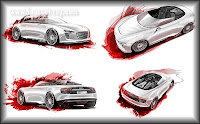
Audi e-tron Spyder

Audi presents the Audi e-tron Spyder, the study of an open sports car, at the fall 2010’s largest auto show. The show car, with plug-in hybrid drive, is 4.06 meters (13.32 ft) long, 1.81 meters (5.94 ft) wide and only 1.11 meters (3.64 ft) high. The two-seater is equipped with a 221-kW (300-hp) twin-turbo V6 TDI at the rear axle and two electric motors producing a total of 64 kW at the front axle.

The Audi e-tron Spyder’s low total weight of only around 1,450 kilograms (3,196.70 lb) combined with the high-torque TDI and the two electric motors results in respectable performance. The car accelerates to 100 km/h (62.14 mph) in just 4.4 seconds, and top speed is electronically governed at 250 km/h (155.34 mph).


Design
The Audi e-tron Spyder features what is without a doubt the most advanced and simultaneously the most consistent evolution of the current Audi design language, while also providing initial hints at the design language of future Audi sports cars. It reinterprets the most important design elements that already characterized the previous e-tron concept vehicles. This also ensures the necessary formal differentiation to the purely electric-powered Audi e-tron shown at the 2010 Detroit Motor Show.

1.81 meters (5.94 ft) wide, just 4.06 meters (13.32 ft) long and only 1.11 meters (3.64 ft) in height: these are the classic proportions of an open, high-performance sports car. Compared to the coupé concept car in Detroit, the length and width have increased by 13 cm (5.12 in) and 3 cm (1.18 in), respectively, to underscore the sporty aspiration of the design. This further enhanced the powerful and compact overall appearance that characterizes both vehicles and links them to the sportiest production Audi, the R8.

Due in no small part to the short wheelbase of only 2.43 meters (7.97 ft) – 22 cm (8.66 in) shorter than that of the R8 – the body of the e-tron Spyder comes across as extremely stocky.

In an apparent homage to motor sports, the frameless side glass surfaces taper downward toward the rear. They form a unit with the windshield, which is strongly bowed and inclined like the visor of a helmet.
Interior
Visual and functional references to the fundamental concept of lightweight construction characterize the purist interior design. They establish a connection between proven Audi genes and new formal hallmarks. Typical for the Audi design idiom is the reduction of the architecture, controls and information output to the essentials in favor of a tidy overall impression.

The slim dash has a curve that extends laterally into the door panels. With no need to allow for a transmission, shifter and cardan tunnel, the designers again took advantage of the opportunity to create a particularly slim and lightweight center tunnel and convex, arching center console for the e-tron Spyder with hybrid drive. The only control element other than that of the MMI is the flush-mounted selector lever for the automatic transmission, which extends upward from the tunnel when the vehicle is started.

The cockpit of the Audi e-tron Spyder is also oriented toward the driver – a further characteristic Audi trait. Instead of the classic instrument cluster, the concept car is equipped with a large, display with integrated MMI functions and flanked by two round dials. The MMI can be controlled via a touch-sensitive control panel on the steering wheel – an element inspired by modern smartphones. It can also be controlled via the MMI control unit (MMI touch) on the center console. The steering wheel itself is clearly flattened off at both the top and bottom, in a clear reference to motor sport. Speed is displayed in digital form only. The dial instrument with information about the drive system can be chosen via the menu item “Drive.”

Besides information about the speed, the revs of the combustion engine and the electric drive, the central display also provides all of the key information from the infotainment and navigation systems.

Characteristic for the concept of the Audi e-tron Spyder is the near total elimination of switches and components such as the ignition. The climate control unit is located to the right above the steering wheel. The display provides temperature and ventilation information. Again drawing inspiration from a smartphone, the system is operated by means of a touch-sensitive control panel.

The equally racing-inspired lightweight bucket seats combine excellent lateral support with comfort. Contrasting colors and stitching delineate the various zones of the interior. The colors and the high-quality materials combine elegance and sportiness.
ASF Body
Systematic lightweight construction is a crucial prerequisite for efficiency and range, while also being the primary foundation for exhilarating driving dynamics. The Audi development engineers drew on the core competence of the company for the Audi e-tron Spyder. The body structure is based on Audi Space Frame (ASF) technology and was realized as a hybrid construction, with the hood and numerous aerodynamic components made of carbon.

In ASF technology, the body's supporting structure is made of extruded aluminum sections and die-castings. Aluminum panels are incorporated into this skeleton to form a positive connection and perform a load-bearing role. Each individual component of the ASF space frame is optimized for its specific task by the use of widely differing shapes and cross-sections, combining maximum stability with minimal weight. Despite the complex drive system layout with two electric motors and their respective drive systems plus the TDI engine, the Audi e-tron Spyder show car only weighs around 1,450 kilograms (3,196.70 lb).
Engines and transmissions
Audi has long proven the perfect synthesis between a highly advanced sports car and TDI technology. With the TT, Audi become one of the first manufacturers anywhere in the world to successfully bring a diesel sports car to market, a decade after the Audi Cabriolet paved the way for diesel engines in this segment. And the Audi R8 TDI Le Mans concept car was the first supercar to be fitted with a twelve-cylinder diesel engine with 500 hp and 1,000 Newton meters
(737.56 lb-ft) of torque.

The Audi e-tron Spyder also draws on this recipe for success – albeit in a revolutionary new combination. This marks the first use of a new generation of the six-cylinder, 3.0 TDI that breathes through two turbochargers and produces 221 kW (300 hp). That is another 50 hp more than the previous stage, which debuted a few months ago in the new Audi A8.

Peak torque of 650 Newton meters (479.42 lb-ft) is unusually high, even in the sports car segment. The mid-mounted, longitudinal 3.0 TDI engine drives the rear wheels via a seven-speed dual-clutch transmission.

Another innovation is the coupling of the TDI with the electric drive of the front axle. Two asynchronous electric motors with a total output of 64 kilowatt (88 hp) and peak torque of 352 Newton meters (259.62 lb-ft) combine with the 3.0 TDI to give the Audi e-tron Spyder the performance of a high-performance sports car. It accelerates from 0 to 100 km/h (62.14 mph) in 4.4 seconds. Top speed is electronically governed at 250 km/h (155.34 mph).

The drive’s characteristic is even more exciting than the abstract numbers. Thanks in no small part to the fact that the peak torque of the electric motors is available immediately, the e-tron Spyder accelerates with catapult-like thrust. Short passing maneuvers on interurban roads can be pulled off as spurts that are every bit as relaxed as they are fun, even without having to downshift.

The noise level of the low-revving TDI is typically low. The six-cylinder unit behind the occupants issues a sonorously sporty growl under load, but never becomes loud. A surprising effect also present in the Le Mans-winning Audi R10 and R15 race cars, which are also powered by TDI engines.

The benefits of this special form of hybrid drive – the coupling of a high-torque, high-efficiency TDI engine with the electric motors – are by no means limited to the dynamic potential of the Audi e-tron Spyder, however. The open two-seater also sets new standards in its class for fuel consumption and environmental characteristics. The 300-hp TDI consumes on average just 2.2 liters of diesel per 100 kilometers (106.92 US mpg), which corresponds to CO2 emissions of only
59 g/km (94.95 g/mile).

The full-hybrid Audi e-tron Spyder has also mastered the discipline of zero-emission driving. In residential and other urban areas, the driver can activate the electric drive by itself. The 9.1-kwH battery at the front of the car has enough power for up to 50 kilometers (31.07 miles). And with a top speed of up to
60 km/h (37.28 mph), the e-tron Spyder is also able to move along smartly in city traffic.


Chassis
The normal distribution of the tractive power is clearly biased toward the rear axle in accordance with the weight distribution of the e-tron Spyder and the dynamic shift in axle load during acceleration. Similar to with a pure mid-engine sports car, roughly 75 percent of the torque goes to the rear and 25 percent to the front. If an axle slips, this balance can be varied thanks to the central control of the entire drive system in combination with the ESP. The hybrid vehicle from Audi thus enjoys all of the advantages of quattro technology.

The combination of the mid-mounted TDI engine and the two electric motors at the front axle also make it possible to intelligently control the lateral dynamics of the e-tron.

Similar to what the sport differential does in conventional quattro vehicles, torque vectoring – the targeted acceleration of individual wheels – makes the e-tron Spyder even more dynamic while simultaneously enhancing driving safety. Understeer and oversteer can be corrected by not only targeted activation of the brakes, but also by precise increases in power lasting just a few milliseconds. The concept car remains extremely neutral even under great lateral acceleration and hustles through corners as if on the proverbial rails.

The chassis has triangular double wishbones at the front axle and a trapezoidal-link rear suspension made of forged aluminum components – a geometry that has proven in motorsports to be the optimal prerequisite for high agility, uncompromising precision and precisely defined self-steering behavior. A taut setup was chosen for the springs and shock absorbers, but it is still very comfortable.

The direct rack-and-pinion steering gives finely differentiated feedback. Its electromechanical steering boost varies with speed, so that the e-tron Spyder only has to provide energy while steering, and not while driving straight ahead.

As befitting its status, the Audi concept car rolls on 20-inch tires with a new blade design. 245/30 tires up front and 265/30 tires in the rear provide the necessary grip.


Come visit my website and enjoy:
And all this still growing !

Labels: , , , , ,