Saturday, December 14, 2013

1963 Giugiaro's Chevrolet Testudo

Bill Mitchell at GM styling sent two Corvair chassis to Italy with an idea towards selling a European styled Corvair on the continent. One went to Pininfarina and the other to Bertone, where Giugiaro was working.
The Testudo held a special place in Giugiaro’s heart. “There’s something special and affectionate about what I feel for the Testudo. It was the first prototype with which I had been given a free hand, without restraints, and the end result captured the attention of the entire automobile world.”
Even if Bill Mitchell’s idea of a localized Euro Corvair never came true, it led to a very influential concept cars, and Tony Lapine himself said that it directly influenced his design of the Porsche 928.

(Testudo is Italian for turtle, an allusion to the sharp beltline separating top and bottom halves of the car)


Labels: , , , , , , , ,

Tuesday, December 10, 2013

2014 Camaro Z/28

The legendary Camaro Z/28 is back for the 2014 model year.
Originally introduced in 1967, Camaro Z/28 was designed specifically to compete in the Sports Car Club of America's Trans-Am 2 class. Lightweight, nimble and incredibly powerful, the original Z/28 was designed ideally for road racing. The 2014 Z/28 carries the same racing credentials, running a lap around the Nurbürgring in an impressive 7:37.47 in inclement weather.


POWERTRAIN
A hand-assembled LS7 engine powers the Camaro Z/28, boasting an incredible 505 horsepower and 481 lb.-ft. of torque, making it the most powerful normally aspirated regular production small block V8 ever. The highest-quality parts and precision assembly elevate the redline level to 7000 rpm. The LS7 is mated to a TREMEC® TR6060 6-speed manual gearbox that features close-ratio gearing - optimized for the engine’s power characteristics. The TREMEC is coupled with a 5.1:1-ratio short-throw shifter to ensure quick and precise shifts


BODY
Camaro Z/28 has aerodynamic treatments designed to produce downforce — specifically at track speeds. A large splitter connects to an underbody panel to further reduce lift. Fender flares over the front and rear wheels and extended rocker panels contribute to aerodynamic stability. Z/28 also features an aggressive rear spoiler and functional diffuser to complete the fully integrated aerodynamic package.


CHASSIS
The tires on Camaro Z/28 are robust and massive Pirelli® PZERO™ Trofeo R† 305/30ZR19 summer-only tires† — ideal for lateral motions, like corner entry and exit. Camaro Z/28 features lightweight Brembo® carbon Ceramic Matrix™ rotors and fixed, monoblock calipers. The huge 394 x 36 mm front rotors are paired with 6-piston calipers, while the 390 x 32 mm rear rotors are paired with 4-piston calipers. Compared to similar-size two-piece steel rotors, the lightweight and large carbon calipers save 22 pounds, while encouraging impressive stopping power and heat toleration — ideal for track use.


INTERIOR
The all-new driver and front passenger racing seats are designed by RECARO®. Aggressive bolsters ensure both passenger and driver remain firmly planted, even in high-energy driving situations. A flat-bottom steering wheel opens leg room for entry and exit, as well as quicker heel/toe shifting. A short-throw shifter allow for rapid, confident shifting.


http://www.chevrolet.com

Labels: , , ,

Friday, October 04, 2013

GM: $131 million investment at Bowling Green Assembly

Four Paths to Corvette’s Strength, Refinement and Quality

$131 million investment at Bowling Green Assembly helps lead to best builds ever
BOWLING GREEN, Ky. – General Motors’ $131 million investment in technology at the Bowling Green Assembly Plant, such as the first production use of a GM-patented process allowing aluminum to be spot welded to aluminum, is resulting in the strongest and most precisely built Corvette in its six-decade history.
New technologies enable more accurate and efficiently produced subassemblies, such as the frame and the components attached to it. Enhanced, laser-based three-dimensional inspection systems verify overall assembly tolerances targeted to be 25 percent tighter than the previous-generation Corvette.


Flowdrill Fastening
The Corvette Stingray’s frame features 188 Flowdrill-machined fasteners with structural adhesive. The fasteners are installed by a high-speed drill that extrudes the frame material to create a strong, integral collar that is tapped for screw-type fasteners. It is a GM first for body structure joining.
Flowdrill fastening joins closed sections, where only one side has open access and where arc welding could cause heat distortion or weaken material. Dimensional quality is also maintained, eliminating the need for post-assembly machining.


Aluminum Resistance Spot Welding
Pioneered by GM, aluminum resistance spot-welding process is an efficient method for joining aluminum to aluminum where there is two-sided joint access. It is particularly effective with the thicker materials – up to 4mm – used on the new Corvette’s frame. It is also used for welding aluminum extrusions, die castings and aluminum sheet metal. There are 439 aluminum resistance spot welds on the Corvette Stingray coupe.
The process is used in the Corvette’s aluminum structure tunnel subassembly and in mainline attachments of various components. Additionally, licensed suppliers use the process to produce a few subassemblies for the car.
GM’s new resistance spot welding process uses a patented multi-ring domed electrode that does what smooth electrodes are unreliable at doing: welding aluminum to aluminum – and it does it more cost-effectively than other methods of joining aluminum. The multi-ring domed electrode head disrupts the oxide on aluminum’s surface to enable a stronger weld.


Laser Welding
Laser welding is used in the frame’s tunnel subassembly to attach sheet aluminum closeout panels to the tunnel structure. The process enables continuous welding quickly when only single-sided access is available.
Additionally, the precise beam of high energy used in the welding process minimizes heat beyond the weld area for improved structural accuracy, and the laser creates a leak-free joint that does not require additional sealing, which could add weight to the frame structure.
There are two robotic laser-welding stations in the plant – one with a pair of robots and another with a single robot. Each robot has a dedicated laser power generator and together, they lay down 71 segments for a total of 37 welded feet on every frame.


Laser Vision Inspection
Laser-based vision inspection for quality assurance now includes Perceptron-supplied tools to monitor critical points on every Corvette body that comes down the line.
By checking every car and major assembly in the plant, process variation can be seen – and addressed – immediately. Tighter tolerances on parts and new, improved tooling for the Corvette’s various assembly procedures are helping the plant achieve approximately 25 percent or greater improvement in meeting tolerance targets.
Perceptron is essentially a three-dimensional measurement system that uses fixed and robotic-mounted Helix laser sensors, or cameras, to monitor critical build features. It is a three-part “in process” quality inspection for frame rail assemblies, uniframe bodies and composite bodies with a fully dressed cockpit.
On the composite body alone, 39 specific points are measured. It takes approximately 2.5 minutes to measure each car in station to within 0.25 mm. One hundred dimensional measurements are taken with each frame assembly.


Labels: , , ,

Wednesday, May 15, 2013

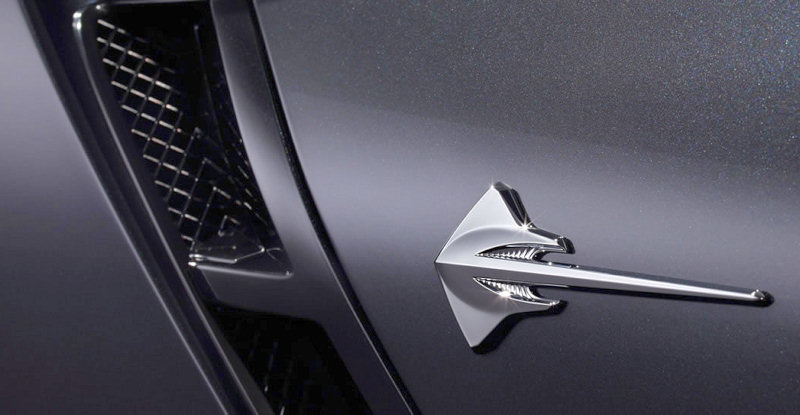
Chevrolet 2014 Corvette Stingray

The Stingray is designed on purpose. Low, light and lean. Provocative, purposeful and sculpted for optimal performance. A beautiful weapon against convention.

AERODYNAMICS
The benchmark of aerodynamic prowess. Functional exterior vents create a totally new breathing experience to reduce lift and minimize drag. Increased downforce keeps the car planted. Advanced ventilation systems flow from front to back, cooling critical components of a perfectly balanced powertrain. Efficient airflow controls temperatures and improves vehicle handling. Stunning design meets racing strategy.

HOOD EXTRACTOR
This is no bottom breather. A functional hood extractor directs hot air from the front grille up and out of the engine compartment. Each blade is precisely angled for optimal airflow. The result is reduced front-end lift, increased downforce and improved handling at high speeds.

BRAKE COOLING
The Z51 Performance Package includes dual brake ducts to transport air from the front grille through the wheelwells to effectively cool front brakes and expel heat. Efficient airflow controls temperature, reduces brake fade and optimizes stopping performance.

POWERTRAIN COOLING
Dual rear quarter panel intake vents guide airflow to cool two separate heat exchangers. One routes air to the transmission oil cooler. The other cools the rear differential. Hot air escapes through tailored rear taillamp vents and lower-rear fascia outlets.
A system adapted from Corvette Racing to reduce temperatures during high-performance driving.

DRIVER MODE SELECTOR
With the turn of a dial, everything changes. Five distinct, selectable driver modes electronically calibrate up to 12 performance variables to customize the car for any road. With the optional Z51 Performance Package, available Performance Traction Management offers five settings of torque reduction and brake intervention for more confident driving on the road.

PERFORMANCE
Engine : LT1 6.2L V-8
Horsepower / Torque : 450 / 450 (estimated)
Fuel delivery : Direct Injection
Compression ratio : 11.5:1
Manual Transmission : 7-speed with Active Rev Match
Automatic Transmission : 6-speed paddle-shift
Chassis : Std, Z51, Z51 with Magnetic Selective Ride

FEAURES AND OPTIONS
Tires : Michelin Pilot Sport ZP run-flat    
Wheels : 18" front / 19" rear, 19" front / 20" rear (Z51)    
Three Available Option Groups :  1LT, 2LT, 3LT
Available Roof Options : Painted Carbon Fiber, Visible Carbon Fiber, Transparent

DATA
Wheelbase (in/mm) : 106.7 / 2710
Overall length (in/mm) : 177 / 4495
Overall width (in/mm) : 73.9 / 1877
Overall height (in/mm) : 48.6 / 1235
Weight distribution (%) : 50 / 50 (front/rear)
Track (in) : 62.8 / 61.6 (front/rear)
Brake Diameter (in) : 12.6 (13.6 Z51) (front), 13.3 (rear)


Labels: , , , , ,